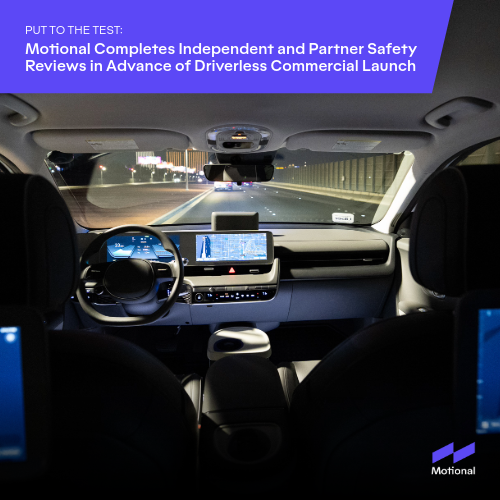
After more than a decade of testing, over 2.6 million autonomous miles driven, and more than 145,000 passenger rides completed, Motional is getting ready to launch driverless commercial rides in Las Vegas.
Autonomous vehicles have the potential to make our streets much safer by eliminating human errors like distracted or impaired driving. Realizing that promise, however, requires a relentless commitment to safety at every level of our organization. At Motional, safety isn't an afterthought or a final checkpoint, it is the core philosophy that guides every engineering decision, operational procedure, and mile we drive.
This philosophy is the foundation of Motional's safety framework for driverless operations, which outlines the methods we use to build in and assess safety across our entire enterprise, from our safety culture to engineering and testing – as well as the capability of our autonomous driving system on the road.
We approach our safety framework through three pillars:
Operate with Responsibility
This pillar details how Motional instills a safety-first culture throughout every level of the organization. It encompasses our internal safety governance and accountability structures, which includes our "Red Button" process that empowers any employee to report potential safety concerns. It also covers human-in-the-loop operational support through Remote Vehicle Assistance agents, who can provide route guidance during unusual scenarios while the vehicle's onboard system retains full driving control. Operational responsibility also means active transparency with regulators and hands-on training with local first responders.
Architect for Resilience
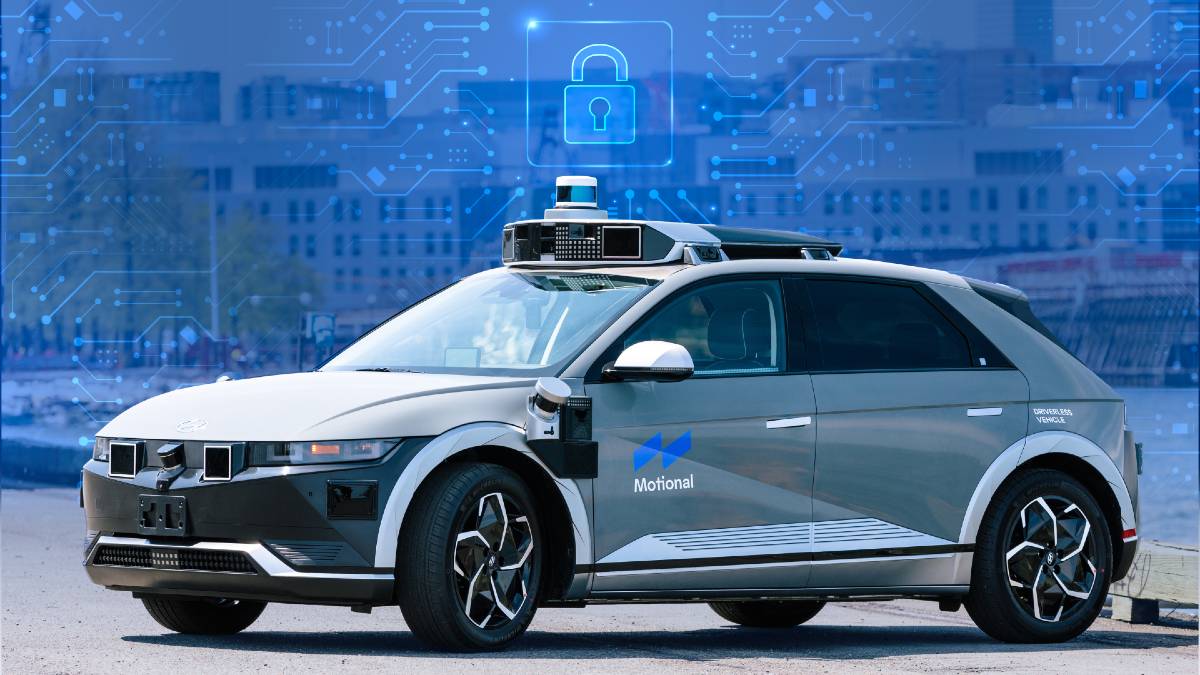
This pillar describes how safety is built directly into the physical and technical design of our IONIQ 5 robotaxis It explains our automotive-grade hardware redundancies across critical systems like steering, braking, power, and onboard computers, paired with 360-degree multi-modal sensing using lidar, radar, cameras, and acoustic sensors. On the software side, it outlines how our system continuously monitors vehicle health, protects against interference, and safely handles unexpected faults.
Drive with Competency
This pillar focuses on proving that our driving software navigates safely and predictably within our defined Operational Design Domain (ODD), the specific roadways, speed limits, and weather conditions our vehicles are approved to operate in. It explains our multi-stage verification and validation process, which begins with large-scale cloud simulation before advancing to closed-course test tracks, and finally supervised public road testing with trained safety drivers prior to driverless operation.
Measuring Our Impact on Road Safety
Through our advanced autonomous driving technology and rigorous safety standards, we can contribute to safer roads. We believe Motional robotaxis can achieve a measurable decrease in injury-causing crashes as benchmarked against human driving datasets representing our Las Vegas operating area. We came to this conclusion based on both structured and simulation testing that leverages real world data and industry standard collision prevention scenarios that together enable a comprehensive measurement of our driving performance in critical safety events and challenging road interactions.
Using the dataset we have developed across more than 1 million autonomous miles driven in Las Vegas, we have defined a suite of critical safety events that we use in simulation as the core set of tests for new software releases. In our simulation testing, we have validated that our robotaxi did not cause any serious injury-causing collisions, including any with pedestrians or other vulnerable road users, such as scooters or cyclists.
We also extracted a set of challenging road scenarios and edge cases from the dataset that define the behavioral capabilities according to AVSC Best Practices, which allow us to confirm our AVs are operating safely in our environment. We use these situations in simulation, including conducting variations of the scenes, along with confirming results through structured testing on our closed course test track.
In addition, we employ the 2026 EuroNCAP Frontal Collision and Low Speed Collision Crash Avoidance protocols as a means to provide additional confidence in our driving performance, validation process and results. Our system passed all of the EuroNCAP cases that apply to our robotaxi without a collision, including scenarios that have interactions with pedestrians, motorcycles, cyclists, and vehicles.
A Living Commitment to Safety
Our safety approach isn’t a static document or process—it is an evolving responsibility inherent to everything we build. Our framework will continuously adapt alongside our technology, informed by every mile driven on public roads.
We hold ourselves to these high standards because safety is not just an outcome we measure; it is the promise we make to our riders, our partners, and other users of the streets we share.
A more detailed overview of Motional’s driverless safety case is available in this white paper.