Our Commitment to Safety
Driven by a foundational mission to make our streets safer, Motional is dedicated to placing safety at the center of everything we build. Ahead of launching Motional’s first driverless commercial service, our team completed a rigorous, multi-year driverless safety case. From closed-course testing to millions of miles of computer simulation and supervised driving, our overall commitment to safety guides a disciplined, evidence-based approach to beginning driverless operations. By grounding every decision in performance data, we are confident our robotaxis will deliver a consistently safe, reliable, and comfortable experience for passengers and the communities where we operate.
Starting With Our Robotaxi: The FMVSS-Certified IONIQ 5 Robotaxi
By combining Motional’s autonomous technology with Hyundai Motor Group’s manufacturing expertise, our strategic partnership delivers robotaxis built from the ground up to true automotive-grade standards. Manufactured at the Hyundai Motor Group Innovation Center Singapore (HMGICS), the all-electric IONIQ 5 robotaxi is a fully integrated Level 4 autonomous vehicle (AV) produced on a dedicated assembly line with factory-installed sensors. As one of the world’s first AVs certified under U.S. Federal Motor Vehicle Safety Standards (FMVSS), it features fully redundant braking, steering, compute, and power systems. Paired with rigorous testing and factory-level calibration, the IONIQ 5 robotaxi ensures the high safety and reliability needed for commercial ride-hailing services.
A look at the production of Motional’s IONIQ 5 robotaxis at the Hyundai Motor Group Innovation Center Singapore
Motional’s Driverless Safety Case
A safety case is a structured argument, supported by a body of evidence, that provides a clear, comprehensive, and valid demonstration that a system is absent of unreasonable risk for a given application in a defined operating environment. Motional developed a safety case to launch driverless robotaxi operations in Las Vegas. Serving as our formal readiness gate, this framework translates high-level safety intent into measurable claims, detailed artifacts, and acceptance criteria.
Motional’s safety case framework aligns with industry best practices for safety, leveraging UL 4600 (Standard for Safety Evaluation of Autonomous Products) as its primary foundation and providing a systematic approach to safety claims, arguments, and evidence. To ensure a comprehensive safety lifecycle, we also integrated targeted methodologies from other established standards, including:
- AVSC Best Practices: Motional’s safety case is informed by principles from the Autonomous Vehicle Safety Consortium(AVSC).
- ISO 26262: Base vehicle platform functional safety and sensor integration.
- ISO 21448 (SOTIF): Behavioral mitigation of performance gaps and unknown environmental conditions.
- ISO 21434 & ISO 8800: Cybersecurity risk mitigation and AI/ML development guidance.
A key tenet of Motional’s approach to safety is our commitment to challenging our work; our safety team continuously works to poke holes in areas of our safety case, questions arguments, and requests new evidence. This diligence is core to Motional’s safety-first culture. We move forward having confidence in our safety claims because they have been routinely put to the test.
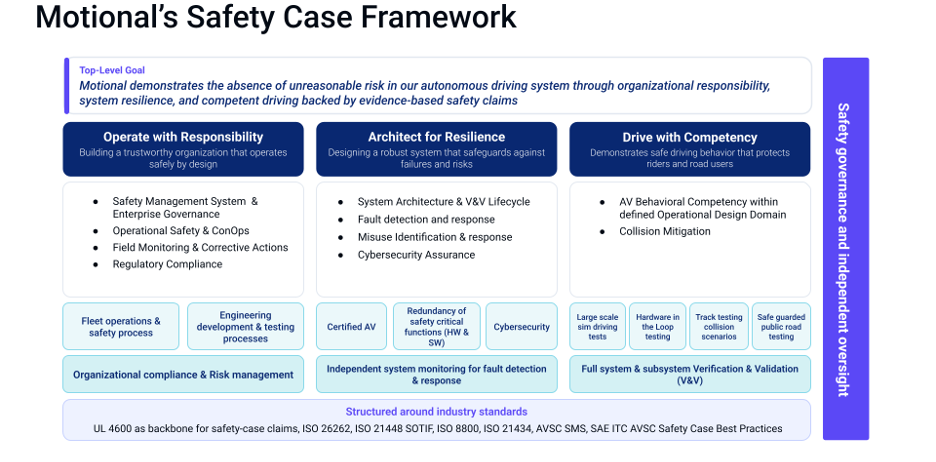
As illustrated in the framework overview above, the three pillars ensure that organizational accountability, hardware and software resilience, and behavioral proficiency operate to maintain safety across the complete lifecycle of our autonomous driving technology.
Our Safety Case Framework is defined by three core pillars; Operate with Responsibility, Architect for Resilience, and Drive with Competency.
1. Operate with Responsibility
Motional prioritizes safety as the foundational core of the AV fleet operations through our comprehensive "Operate with Responsibility” pillar. At the heart of this approach is an Enterprise Safety Management System (SMS), overseen by an executive Safety Review Board, composed of function leads from across Motional, that governs risk acceptance, deployment readiness, and organizational integrity. Motional enforces a safety-first culture across its entire workforce, from mandatory safety onboarding and annual training recertifications to a non-retaliatory reporting environment supported by internal investigation programs. Every deployment decision is backed by a quantitative Safety Risk Management program and rigorous internal auditing to systematically identify, evaluate, and mitigate potential operational hazards.
Before beginning autonomous operation on public roads, Motional combines stringent operational protocols with advanced system engineering. Operations are bounded by an Operational Design Domain (ODD) that manages real-world factors like weather, infrastructure, and dynamic road actors in real time. Autonomous operation is supported with humans-in-the-loop through Motional’s Remote Vehicle Assistance (RVA), where a human agent can offer guidance to the AV for a complex edge case scenario. The human agent can never take control or conduct remote driving, and the AV decides whether the guidance is safe or to request an alternative resolution.
2. Architect for Resilience
Motional’s "Architect for Resilience" pillar sets the enterprise standard for hardware and software fault tolerance, ensuring system safety during internal component failures or external disruptions. Grounded in functional safety and system-level hazard analyses, the platform is designed so that no single point of failure introduces an unreasonable risk. At its core, the IONIQ 5 robotaxi features fail-operational redundancies across critical steering, braking (including the vehicle’s Automatic Emergency Braking (AEB) system), propulsion, and communication pathways. Dual vehicle interface controllers (VICs) continuously monitor system health, while multiple distributed fault collectors spanning the High-Performance Computer (HPC), VICs, and vehicle platform coordinate real-time responses. Depending on fault severity, the system automatically triggers an appropriate Minimal Risk Maneuver (MRM), ranging from controlled, stopping actions to maximum full-vehicle braking, to safely bring the vehicle to a complete halt.
Engineering integrity is maintained through a multi-stage, continuous verification and validation (V&V) pipeline informed by leading automotive standards. Before any software update reaches public roads, it must pass high-density regression suites, hardware-in-the-loop (HIL) testing, and large-scale resimulation against hundreds of thousands of driving miles. A structured Safety Investigation Procedure tracks safety signals, conducts root-cause analysis, and deploys corrective actions across the fleet. Final driverless deployment authorization rests with the Safety Review Board, ensuring evidence-based safety decisions.
Motional’s resilience strategy employs proactive safeguards to proactively mitigate potential issues. Passenger cabins are continuously monitored via the cabin monitoring system (for more information view Motional’s vehicle user privacy policy), and in-cabin safety checks enforce seatbelt and door compliance before and during rides. To address passenger or public interference, such as physical tampering with controls, the system ignores unvalidated passenger inputs, displays warnings, triggers MRMs, and escalates to RVA or specialized Field Response Teams for physical recovery and law enforcement escalation.
3. Drive with Competency
Motional’s "Drive with Competency" pillar establishes the behavioral intelligence, perceptual accuracy, and decision-making capabilities required for the AVs to navigate complex road environments safely. Anchored in Safety of the Intended Functionality (SOTIF) principles, the autonomous driving system accurately detects surroundings, predicts the movements of vulnerable road users and other vehicles, and executes safe, predictable maneuvers within the defined ODD. Performance is validated through a multi-modal evaluation process, combining simulation, closed-course testing, and extensive public road data, to ensure safe operation.
To continuously measure and verify behavioral safety, Motional relies on a formal Safety Metrics Governance Framework. System performance is evaluated against rigorous benchmarks established using expert human driver data, aggregate population crash statistics, and technical risk models. Motional tracks both quantitative and qualitative Safety Performance Indicators (SPIs), such as collision rates, near-miss rate, harsh dynamic maneuvers, and traffic rule compliance. Objective sensor-driven data is paired with subjective vehicle operator (Motional’s vehicle operators are highly trained, full-time employees) feedback to address leading indicators of risk early, ensuring that safety-critical updates are validated through resimulation and verified through executive oversight before fleet deployment.
Putting Our Safety Case Through Independent Reviews
Motional validates its safety case through internal oversight and external third-party evaluation. Internally, final driverless readiness decisions are governed by Motional’s Safety Review Board. Externally, we work with partners and experts to review our safety approach:
- TÜV SÜD, an independent safety assessor, assessed Motional’s safety case program and confirmed its conformance with the AVSC Best Practice for Safety Case Assessment (AVSC-D-04-2025). As part of the broader engagement, TÜV SÜD also assessed the structure of Motional’s driverless safety case and reviewed supporting evidence against defined assessment criteria and applicable state-of-the-art expectations. Overall, the assessment confirmed that the safety case structure aligns with relevant industry best practices and provided an independent evaluation of Motional’s approach to developing, supporting, and maintaining its driverless safety case.
- Our partners at Uber reviewed Motional’s safety case and program for alignment with Uber’s Safety Guidelines for Autonomous Mobility and Delivery Providers on the Uber Platform, a required step before deployment on the Uber network.
First Responder Engagement
In order for AVs to safely integrate into communities, they must correctly perceive and respond to first responders including police, fire departments, and other emergency personnel. Motional prioritizes public safety across our technology development and operations, including how AVs react to emergency vehicles. Our team collaborates directly with police, fire departments, and emergency personnel in Las Vegas and Pittsburgh to provide comprehensive education on vehicle identification, emergency response protocols, and safe roadside interaction. Effective first responder engagement is a critical part of our operational readiness, and we will continue to work closely with our local partners.
Completion & Continuous Verification
Motional’s safety case is a living, continuously updated model rather than a static document. Supported by over 2.6 million miles of supervised public road testing and extensive multi-stage simulation, closed-track validation, and hardware-in-the-loop testing, our claims are continually measured against empirical evidence. As our driverless services expand, ongoing operational data feeds directly back into our safety process, ensuring that the absence of unreasonable risk is sustained across every mile driven.
A more detailed overview of Motional’s driverless safety case is available in this white paper.